

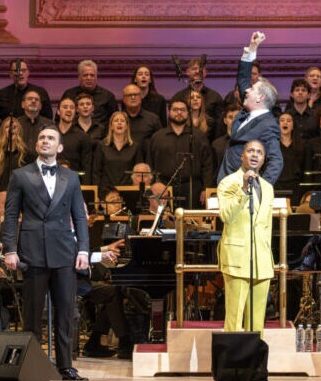
By Marilyn Lester ***It can’t be easy to condense the music of 250 years+ into two hours, but that task was given the old college try by the New York Pops under the leadership of Music Director and Conductor Steven Reineke, The concert, The Music of US: From Then to Now, at Carnegie Hall’s Stern Auditorium/Perelman Stage, certainly 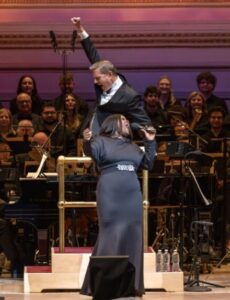 was a worthy effort, and as W.S. Gilbert might say, “modified rapture.” The program was a project that Reineke had been working on and putting together over several years as part of Carnegie Hall’s “United in Sound: America at 250” festival—a nationwide celebration marking the 250th anniversary of the signing of the Declaration of Independence. Reineke’s narrative was, in essence, a history lesson, but an entertaining one, his text concise and pithy.
Eschewing the usual concert start of an instrumental feature, the opener was a striking and beautiful departure: “First Song,” a gorgeous traditional indigenous piece performed on American courting flute by Tchin, an artist of Blackfeet and Narragansett heritage. This haunting, uplifting tune profoundly anchored the evening by acknowledging the first peoples of the Americas. That statement made, the Pops, with the massed choral voices of 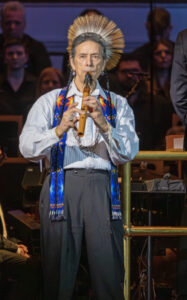 Essential Voices USA (who provided “backup” on many of the songs), directed by Judith Clurman, launched into the mighty sound of William Billings’ uptempo rouser, “Chester,” a kind of “go-America” anthem of the Revolutionary War. Enslavement, emancipation and the African American experience were represented in “Lift Every Voice and Sing,” written in 1900 by brothers James Weldon and J. Rosamond Johnson, which became known as the “Black national anthem,” and which was reverently sung by Nova Payton.
It was at the turn of the 20th century that an amazing musical turn of events happened—it was around this time that a great confluence of rhythm: gospel/spirituals, the blues, ragtime and Eastern European klezmer music eclipsed traditional Western European-based songs and instrumental waltzes. These powerful polyrhythms birthed protojazz, jazz and popular music. Scott Joplin’s “Maple Leaf Rag” was a juicy Pops feature, which preceded the popular music of Tin Pan Alley, but a whole chuck of important foundational American music was missing: where was the music of wildly important founders James Reese Europe, Jelly Roll Morton, W.C. Handy, King Oliver, Louis Armstrong, 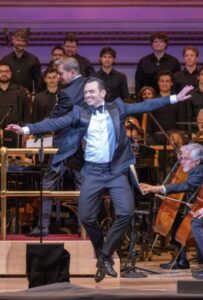 Fats Waller, and most egregiously of all—America’s premiere musical genius, Duke Ellington? The legacies of the Gershwins and Irving Berlin are well-known and could easily have been minimized in favor of these other important founders of American popular music.
Many of these Act One tunes were sung by the talented Tony and GRAMMY nominee Ephraim Sykes, but the wonderment of the concert was Max Clayton, known especially for The Music Man, who just might be the reincarnation of George M. Cohan. His rendition of “Give My Regards to Broadway” was a singing, dancing one-man fiesta of show biz pizzazz. In Act Two, Clayton delivered a truly amazing, wonderfully over-the-top and masterful star turn of “Once in a Lifetime” (David Byrne, Brian Eno, Chris Franz, Jerry Harrison, Tina Wymouth).
Act Two widened the lens of American music, covering the last 70 or so years. The musical travelogue covered Bluegrass (an instrumental of Earl Scruggs “Foggy Mountain Breakdown with guest artist, banjoist , Hilary Hawke, and with violinist 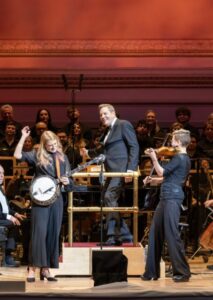 Sara Caswell, who was sitting in with the Pops); Folk (an all-cast “This Land Is Your Land” by Woody Guthrie); and Country (Payton singing Willie Nelson’s “Crazy” and Clayton with Carl Perkins’ “Blue Suede Shoes”). Disco was acknowledged by Payton in Paul Jabara’s “Last Dance,” while Michael Jackson was the choice for rock ‘n roll, via Sykes. Reineke’s narrative in this Act gently touched on social and political themes via the Guthrie tune, as well as in Syke’s rendition of Sam Cooke’s “A Change Is Gonna Come,” and in an all-cast finale of the moving, “Glory” (John Stephens, Lonnie Lynn, Che Smith).
The Music of US: From Then to Now was surely a case of “You can please some of the people all of the time, you can please all of the people some of the time, but you can’t please all of the people all of the time,” but by and large, Reineke and the Pops delivered an entertaining program with educational value. There’s much to know about our music—America’s gift to the world.
Photos by Richard Termine