



By Bart Greenberg***At The Green Room 42, a new musical, Christopher Robin & Pooh, by Harper Craven got a concert presentation under the direction of Andrew Winans. All of our old friends were there: Tigger and Owl, Piglet, Kanga and Roo and all the rest made famous over four stor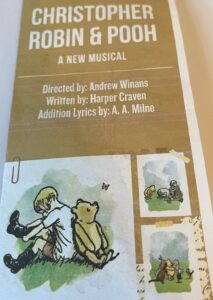 ybook volumes by English author A. A. Milne. The premise of the story is that this is the last day the boy Christopher will visit his animal friends in the Hundred Acre Wood before he leaves for school. A good premise but not quite successful in the material that was on display.
With a very little time for rehearsal, the cast was impressive. A mix of adults and children, they all held their own. Some of the most outstanding were Caroline Purdy as the loving mother Kanga, with her puzzling child, Roo, as played by the youthful Lyla Randall. Another child performer who was notable was Baileigh Elisabeth Shank as Piglet (she seems destined to play Annie down the road). Collin Geter, wi th an ideal powerful bass voice, delivered a doleful manner to the donkey, Eeyore, and Kevin T. Mazur infused manic energy into Tigger. Andrew Gasparini brought sweetness and charm to his portrayal of the title ursine soul, whom Milne lovingly characterized as a “bear of little brain.” Sebastian Towns was the other half of the title duo.
Special mention must be made of the narrator, a stand-in for Milne—Jon J. Peterson, who delivered the rhymed couplets with wit and charm, and captured the heart of the work. But the score was less successful at that endeavor for two reasons. First, a surprisingly few number of the songs had anything to do with the scant story. It wasn’t until the sixth number, “Christopher Robin Is Going,” that the premise stepped for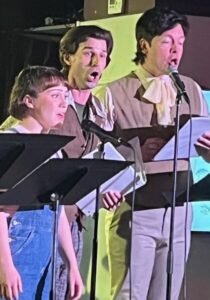 ward. A few songs obliquely commented on this theme, such asKanga and Roo’s “Growing” and Piglet’s very touching “I’ll Be Brave for You;” notably, these were some of the stronger numbers. The rest were basically character songs that had no dramatic thrust.
The other, second, surprise about the score was how angular it is. While not atonal or discordant, there were certainly very few recognizable melodies to grab onto—no one was walking out of the room humming any particular tune. This was a disconnect that doesn’t quite add up to immersion in the world of Pooh. Nor was there any suggestion of England or the bucolic world of the Hundred Acre world, with the exception of “Sing Ho! For the Life of a Bear.” But note, this tune was written by Milne, who also wrote music for his stories.