


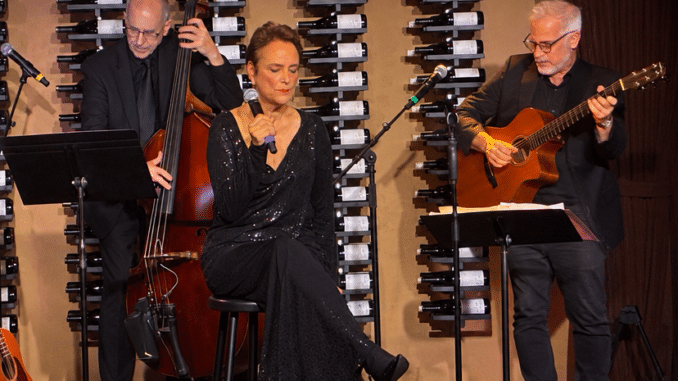
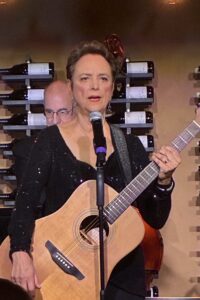
By Marilyn Lester***It’s been a great run, and this last terrific iteration of String Theory at the beautiful new club Hudson Local was made even better with the announcement that the quartet will be back with a new show. The Bistro Award winning foursome is a musical embodiment of particle physics’ string theory, the incorporation of all four of nature’s forces into a single unit. And what a metaphor: 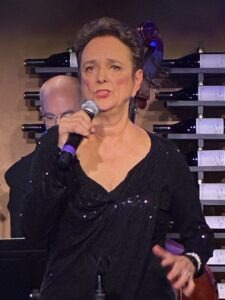 Daryl Kojak (piano), Sean Harkness (guitar), Tom Hubbard (bass) and vocalist-guitarist Deborah Stone all play string instruments (and yes, the piano is technically both a percussive and string instrument). From the first notes of opener, a jazzy fusion of “Here to Love You” (Michael McDonald) and “This Is My Night” (Chaka Khan), more than musicality took center stage; this is a group with a remarkable synergy. There’s an ineffable bond here, a quartet of players that demonstrate their love of making music together in every note.
Among the numbers of a very eclectic set was a reimagining of the 1929 standard, ”More Than You Know” (Vincent 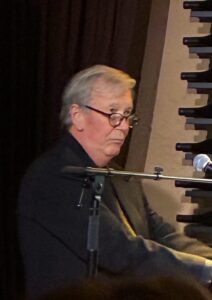 Youmans, Billy Rose, Edward Eliscu), proof positive of why Great American Songbook material is still relevant: they’re musically flexible and tell essential stories. In this arrangement, Stone with guitar, sang evocatively at a slow tempo. With elements of jazz and R&B, and backup vocals by “the boys,” the result was a winner. From the same source, the musical play Great Day, Youmans, Rose, Eliscu’s “Without a Song” was sung in an exquisite interpretation. Stone is a thoughtful singer, on the other side of the scale of power belter, and her solid, smooth vocal tone yielded an interpretation of great depth, the meaning of the lyric deeply felt. Perhaps not as well known among GAS tunes is 1941’s “When the Sun Comes Out” (Harold Arlen, Ted Koehler), perhaps most notable as Barbra Streisand’s fi
 rst commercial single, paired with “Happy Days Are Here Again” (Milton Ager, Jack Yellen), released in 1962.
A trio of songs from cabaret colleagues of renown were thoughtfully included in the set. “Hot in Here” (Amanda McBroom) was rendered in a bluesy style, while Stone, with guitar, offered a slow sensitive reading of Tracy Stark’s “A Better Place.” Lina Koutrakos, who directed String Theory, was represented in “Oh, My, My” in a fun R&B-ish delivery. “Good Times” (Hugo Peretti, Luigi Creatore and George David Weiss) was a hat tip to the Brill Building, home of pop hit-makers of the 1950s and 60s. This prolific creative team wrote chart-toppers such as Elvis Presley’s “Can’t Help Falling in Love” and much more. The more obscure “Good Times” was first released in 1966 by Steve Lawrence, and in Stone’s hands was squarely 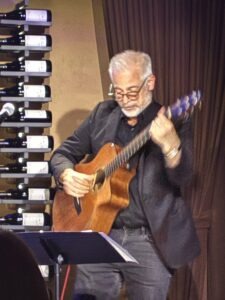 in the “songs of experience” category. Rising to the top was a surprise entry to the mostly bluesy set list, an out-and-out jazzer in Dizzy Gillespie’s toe-tapper, “A Night in Tunisia” with lyrics set by Jon Hendricks. Spotlight features for Kojak and Harkness added to the uptempo pizzazz. Kojak’s arrangement of “You’ll Never Get Away from Me” (Jule Styne, Stephen Sondheim), another uptempo outing, put a stamp on Stone’s ability in jazz and raised the hope that she’ll tackle more of it, including vocalese.
Encore was the gentle and reflective “Some Other Time” (Leonard Bernstein, Betty Comden and Adolph Green), written in 1944 for Broadway’s On the Town. The number appears near the end of the show as the four protagonists wonder about their future as their night on the town comes to an end. With Stone announcing that String Theory will be back, thankfully, wondering was not a matter of if, but when.