

Marilyn Lester***No, actually, it isn’t all about the bass. It’s all about the drum, as Duke Ellington revealed in his whimsical, but spot-on 1959 suite, A Drum Is a Woman, which traced the path of the drum from Mother Africa to the jazz joints and concert stages of the contemporary world of the ’50s. To put a resounding 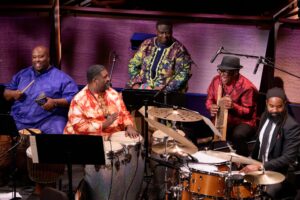 button on that history, Wynton Marsalis and the Jazz at Lincoln Center Orchestra performed From Cuba to the Crescent City, a window into the importance of the drum in American music, and the reason for it importance—a direct consequence of the slave trade. From West Africa, where most slaves were taken, the drum arrived in the New World and was immediately banned in the American South. Not so in the Caribbean, where African beats were incorporated into the musical development of the islands, particularly Cuba. It was early jazzman Jelly Roll Morton who noted, jazz
 requires a “Spanish tinge”—a reference to the habanera and clave rhythms imported from Cuba. With Emancipation in the U.S., the drum found its voice in travel from the West Indies to New Orleans, where jazz was born. Eventually, those rhythms followed the Mississippi up to Chicago and then points West and East.
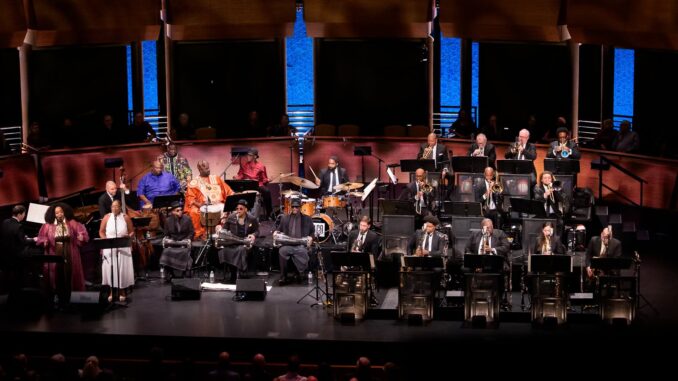
From Cuba to the Crescent City encompassed three suites—Ochas, Afro and Congo Square— revealing the influence of Yoruba, Ghanian and other West African rhythms into what Ellington called “American music.” In addition to the Jazz at Lincoln Center Orchestra, a convocation of percussionists made the case, including the featured 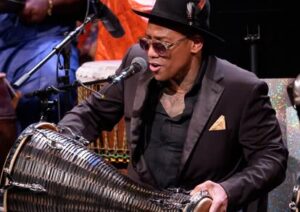 Pedrito Martinez and djembe virtuoso Weedie Braimah. Marsalis’ brilliance not only for composing but arranging was on full display in this visionary program.
The template and tone was revealed in the opener, from 2006’s Congo Square (Marsalis, Yacub Addy), “Place Congo.” As in all movements played from the other suites, Marsalis’ Afro and the traditional Ochas, arranged by Marsalis, the over-arching pattern was a genius for intricacy. Woven in and out of each piece, band performance, specialist percussionists and vocals built the thematic arc. As is the standard for the orchestra, arrangements featured soloists from all sections and members of 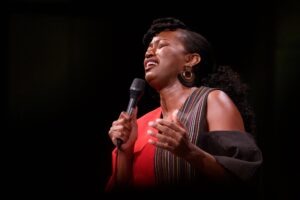 the band. In “Place Congo” the cosmopolitan feel of the music traded with the African rhythms that helped create the music that built the modern city. The following piece, also from Congo Square, “Sanctified Blues,” saw trombonist Chris Crenshaw, with tuba, move into the percussion section (set up adjacent to the bandstand); the integration of the tuba, the precursor of time-keeping via the double bass, underscored the heart of the blues in protojazz and jazz.
Integral to the culture of West Africa was the religion of what came to be called Santeria in Cuba, in which divine spirits, orishas, were sent by the supreme creator to guide humanity. Two movements of Ochas: “Obatala” (the creator) and “Oschun” (the feminine ideal) offered a complex, multipartite creation of sound 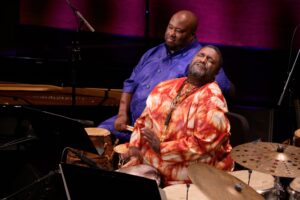 through brass, drumming and vocals, with the pulse of the music ranging from balladic to thunderous. The concluding Afro suite was written in 2025 to represent the voices of the African diaspora. Among its rhythmic and stylistic varieties were operatic and symphonic elements with jazz underpinnings, and brass motifs. Featured vocalist, Shenel Johns, was outstanding in the intermittent parts she was called upon to interpret, particularly in the final movement, “The Forever Now,” which tied together the ancient rhythms of Africa with the modernity of New Orleans jazz.
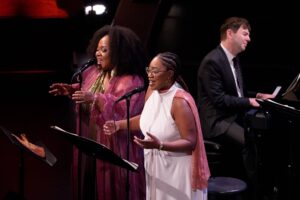
The program, From Cuba to the Crescent City was a masterpiece in itself, drawn from three individual master works. Joining Jazz at Lincoln Center Orchestra master drummer, Obed Calvaire, and in addition to Martinez and Braimah, were virtuoso percussionists, Kofi Hunter, Amoa Opare, Juan Luis Fuentes and Onel Matos Somoza. Vocals were also offered by Jadele McPherson and Amma Agyapon. This memorable evening was not only a jewel in the crown of the Jazz at Lincoln Center Orchestra’s repertoire of great performances, but a fitting tribute to the last season at the helm of guide-star Wynton Marsalis.
Photos by Gilberto Tadday