



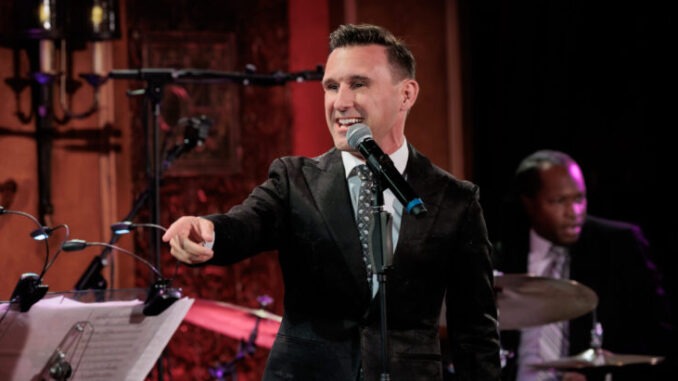
By Marilyn Lester***Vocalist, actor and all-around entertainer, Nicolas King, has just released an album: No Bad Chords. It isn’t his first, and on all the previous ones, three to be exact, his music director-arranger was the late superstar, Mike Renzi. 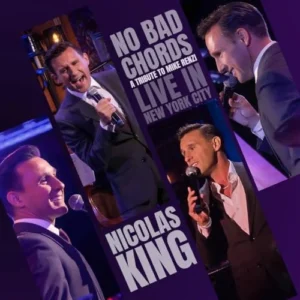 What sets this new release apart is that No Bad Chords is about Renzi—and it is, plain and simple, a spectacular tribute.
The Rhode Island-born Renzi died unexpectedly from a heart attack, at a youthful age 80, on September 29, 2021 in Newport. Five years later, on what would have been his 85th birthday (April 28), King honored his friend, mentor and musical director with a spectacular concert at 54 Below, recorded for posterity in the live album, which received a celebratory release on October 3 at the venue. In a sense, the show was an encore, but with a mighty purpose: a document of more than music, but of that ineffable set of qualities that make music a transcendent force of pleasure—and healing—in human life. The album’s 16 tracks (which include a few clips of narrative), begins 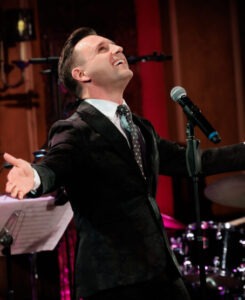 with an energetic, uptempo burner of “Yes I Can”/”I Can See It” (Charles Strouse, Lee Adams/Harvey Schmidt, Tom Jones). As in the show, the tune sets the stage perfectly for the joys that follow on the album.
Considering the original recorded concert, and the release show, it would be difficult to dispute the venue as the ideal location. 54 Below is elegant, intimate and welcoming. Plus, the technology and skills necessary are nonpareil. In other words, it would be hard to imagine a room so perfect for a live recording of such warmth and with a goal so personal. And right at home were the members of the band: virtuoso arranger-pianist Tedd Firth, with longtime Renzi bassist Alan Bernstein and drummer Mark McLean. It’s no small feat that Firth played Renzi’s arrangements so impeccably; that’s technical. But through his fingers came the empathic artistry of Firth channeling the soul of Renzi. Taken together, all of these elements and participants represented a cohort of genius.
A glorious “Johnny One Note” (Richard Rodgers, Lorenz Hart) not only gave depth to a rather silly novelty tune, but spoke to the Renzi-King collaboration. A precocious King, a show biz professional from age four, successfully used it as his audition number. Renzi elevated the tune to have a meaning that escapes many singers. Herein is a key—a genius musician found the perfect vessel for expressing his work. And the beginning of that partnership was a meet-cute: two Rhode Island boys run into each other in a local pizzeria. King is a gifted 17-year old. Renzi is an established A-list music director with a killer resume. They talk and a month later, and for the next 14 years, a psychic, artistic and entirely deep relationship has ensued. “Lucky to Be Me” (Leonard Bernstein, Comden and Green) says it all very well.
The best working with the best, two times over, was expressed in Renzi’s  demanding arrangement for the great jazz singer Mel Tormé in “Pick Yourself Up” (Jerome Kern, Dorothy Fields). Another sublimity comes with a joyous, one-hundred-percent fast and fun version of “Ding Dong! The Witch Is Dead” (Harold Arlen, E.Y. Harburg). The actor in King knows his way around a lyric; his interpretation of “(Ah, the Apple Trees) When the World Was Young” (Pillippe-Gérard) was as sensitive as they come. But why is this album called No Bad Chords? The liner notes explain it: King reveals how Renzi listened to lyrics, and what “no bad chords” meant to him as a way of life.
And while No Bad Chords (with its snippets of narration from the April concert) is a must-have. There is ultimately no substitute for live programming. At the end of the album release concert, the lights dimmed, an image of Renzi blazed from the dual monitors, stage left and right, and a track of Renzi’s mastery began. Alone on stage, King sang a deeply powerful, heartfelt “I Remember You” (Victor Schertzinger, Johnny Mercer). In those moments of magic, one could hear the proverbial pin drop.
Photos by Conor Weiss