

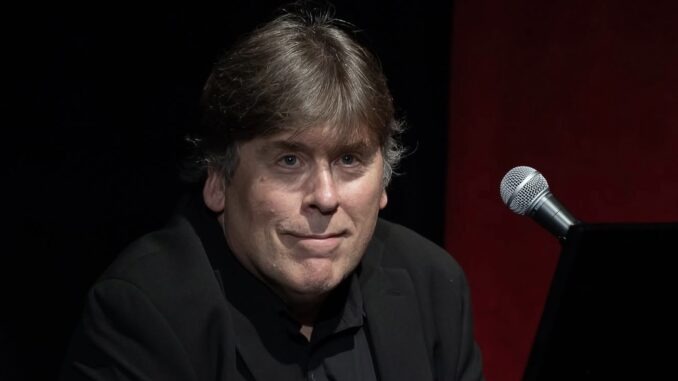
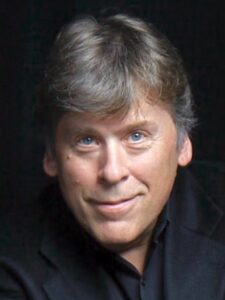
Music director, pianist-arranger and composer, John M. Cook, has long been an in-demand cabaret accompanist, with a list of credits including Josephine Sanges, Renee Katz, Cindy Firing, Deborah Stone and others. He’s a graduate of Northwestern University, and a BMI Scholarship winner for his symphonic suite, The Rime of the Ancient Mariner. His musical chops began as a toddler, picking out notes on a piano, and at age five, hearing Maurice Ravel’s Daphnis et Chloé Suite No. 2, conducted by Leonard Bernstein, made an impression on Cook, leading to piano studies and a profession in music.
His own Find the Road: A John M. Cook Anthology, debuted in 2024 to great acclaim and has now been immortalized on an album—available on CD and all major platforms, including Apple Music, Amazon Music and Spotify.
NiteLife Exchange (NLE) asks John. M. Cook (JMC) Six Questions:
NLE: You’ve served as music director and pianist-arranger for numerous cabaret artists, both live and on recordings. Is Find the Road: A John M. Cook Anthology your first opportunity to put your own music center stage?
JMC: The first time in more than thirty years. What’s that song? “Fools rush in/where angels fear to tred.” The whole project was based on a dare. In February 2023, my friend Nancy Osman, who was a great lover of cabaret said “When are you going to do something of your own?” Oddly enough, it was the right comment at the right time; it got me moving. Over the following summer, I wrote 14 of the 17 songs. The other three are reupholstered from previously-unproduced musicals of mine.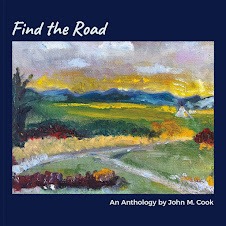
NLE: What was your inspiration for composing and writing Find the Road? To what degree did your past as a music-director inform how you reached the final result?
JMC: One of the great things about working in cabaret is that you get to learn a lot about people. I’ve been privileged to work with some very fine singers and directors. Often the material they select is a biographical blueprint for who they are as people. I’m drawn to the underdogs in life, people who have suffered some cruel twists of fate and made something beautiful in their humaness. Sometimes in songs, I’m drawn to write about characters who know what’s best for everyone else but themselves. Being human, we all have a longing and restlessness—to be of value, to make our lives matter. It’s those people I try to capture.
NLE: What was the process like for birthing the work, from inception to putting notes to paper to knowing the piece was ready to perform?
JMC: Oh, lots of legal pads. Lots of Ticonderoga pencils. They have terrific erasers. At the start of everything I write two questions: “What is this about?” and “What do I want to say?” Otherwise, I’ll waste hours coming up with rhymes that initially I’ll think are pretty great, but in the end I can never use, because I didn’t stick to those two questions. One theme I keep returning to in spite of myself is the man or woman who doesn’t feel their life adds up to all that it should. People who want to change but haven’t a clue as to how. How do I get there from here?
As for how to know when it’s ready to perform, I’m never 100% sure it IS ready. For this show I was gifted to have four superb singers: Josephine Sanges, David Baida, Kristoffer Lowe and Sierra Rein ( I wrote the Star Trek parody “Uhura” for her to sing,  because I knew she was such a sci-fi geek). When you make the switch from writer to listener, and experience it through the filter of a great interpreter, the song reveals itself.
NLE: When did you come to realize that the work needed to be recorded. What was the studio process like?
JMC: I began hearing all sorts of orchestral timbres with the songs. Places where lyrics could be enhanced by different instrumental colors, so I started orchestrating all the pieces. Although the recording features sixteen instruments it was recorded in sections in a studio 24 x12. I’ve worked with my engineer Sean Swinney for thirty years, and no matter how ambitious the project is, he finds ways to accommodate it. Tom Hubbard and I spent two sessions laying down piano/bass tracks. After that we layered on the vocals, strings, woodwinds and brass. It’s always fun on those days when  you put the viola part on the cello stand. Then, realizing you forgot to bring the cello part, having them try and read it from the whole score. The mix down is always sweet agony because there are so many possibilities you need to boil down to a precious few
NLE: Find the Road premiered at Don’t Tell Mama in 2024, was nominated for a MAC Award in 2025, then returned to Mama’s with two recent performances in 2026. Has the show evolved since its original conception? If yes, how?
JMC: Oh yes, and his name is James Beaman. In the original show, since it was an anthology show loosely themed, I foolishly decided not to have a director. However, for the CD launch show I showed James the material and he took things in a different but completely clear-headed direction. So in a way, I got to hear it all born again. The  players interact with one another far more in this version. Moods change on a dime. They become actual characters. I’m very grateful for his input, and thrilled to see he’s getting busier and busier.
NLE: What are your plans for taking Find the Road, well, further down the road? And peering into the future, is there another anthology/song cycle/suite banging on the creative door to be realized?
JMC: No plans at present for another stage show, I’m hoping to let the music travel for awhile. I’m finishing up some piano recordings in early November—one of which is an original jazz suite called ‘ludes and ‘tudes. Then in February, unveiling a new show for Josephine Sanges. No two days are alike, which allows me a fresh perspective, no matter what I’m working on.