





By Bart Greenberg***In 1946 master director Frank Capra released the film It’s a Wonderful Life via his own company, Liberty Films. Never heard of Liberty Films? They released one more film, in 1948: State of the Union, also directed by Capra—and then the company was bought by Paramount. Wonderful Life was relatively popular at the box office but lost a lot of money. The movie cwas nominated forfive major Oscars, winning none, losing four to The Best Years o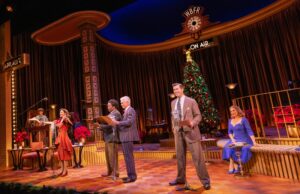 f Our Lives.
And then Wonderful Life kind of got lost. So lost that it fell into public domain in the early ’70s—and as a consequence instantly became a Christmas standard on independent TV channels who could run it without paying any rights. And this legal status is evidently why the new show on Broadway, It’s a Wonderful Life: A Live Radio Play, only credits the film’s source material, the Philip Van Doren Stern short story The Greatest Gift— and not the film screenplay, even though Joe Landry’s adaptation is mostly straight from the movie.
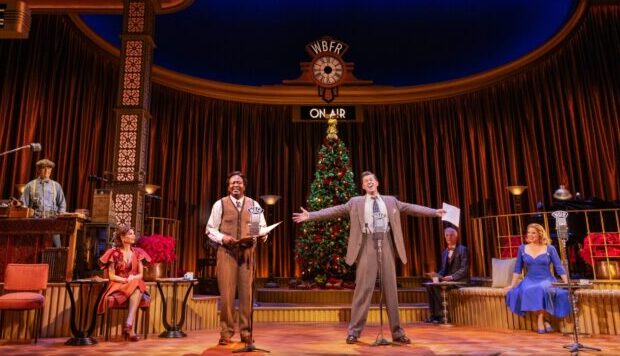
As the subtitle suggests, the action has been shifted to a New York City radio station on Christmas Eve in the early ’50s. Five enthusiastic actors, with the assistance of an excellent sound effects man (Leslie Bloome) and an on-stage pianist (musical director Andy Einhorn) providing a steady stream of backgroundmusic, play all the roles. While Andrew Rannells as George and Megan Hilty as Mary stick pretty close to thos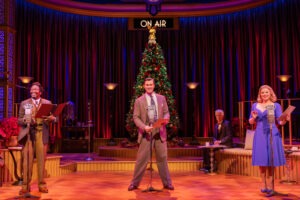 e parts, the other three jump from character to character with impressive versatility. So, Harry Hamlin manages to inhabit both George’s idealistic father and his evil banker nemesis (including in one moment where he is playing both of these men at one time with clear definition). And Tituss Burgess gains great laughs as the dithery Uncle Billy (though he doesn’t quite clarify his alcoholism) and the naïve angel-second-class Clarence with great heart. Lisa Rinna had gleeful fun playing several bratty little girls and the more mature lady of dubious virtues ,Violet; her attempt to play George’s mother isn’t quite as effective but she gives a good try.
Rannells really captures the frustration and the joy of his character. It’s a completely enchanting performance. He also at times recreates Jimmy Stewart’s stuttering delivery—a lovely tribute to the role’s originator. Hilty has less to do, but brings a quiet honestyto the one-man woman while avoiding the more sticky sweet aspects of her personality. Happily, she also gets to display her gorgeous vocal abilities at the end of the evening.
Landry accomplished a very effective trimming down of the two-hour-plus screenplay to an hour-and-twenty-minute play, while retaining both it’s plot and it’s heart with clarity. He also invented one very touching new 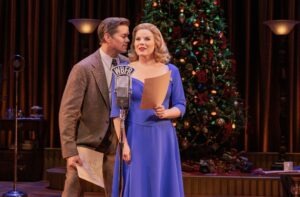 scene between George and Mary during the nightmare sequence that gave both actors a chance to expand on their characters. The entire production is under the very skilled and experienced hand of Jerry Zaks. Not only does he draw fine performances out of his company, but he finds enough natural movement to keep the stage picture from becoming static and dull. The production has also been given a glamorous physical design with set and costumes by Santo Loquasto and lighting by Kenneth Posner.
It’s a Wonderful Life: A Live Radio Play succeeds in being exactly what it wants to be: a charming holiday celebration with great theatrical style, a solid acting ensemble and a lot of heart. Will it deeply ingrain in your soul as a dramatic memory? No. Will it send you out of the theater feeling a bit better than when you walked in? Definitely.
It’s a Wonderful Life: A Live Radio Play runs at the Broadhurst Theatre, 235 W. 44th St., NYC through Jan. 3, 2027. Tickets may be purchased via Telecharge.com or at the theatre box office.
Photos by Matthew Murphy and Evan Z